On the Siuslaw, a former ranch transforms for salmon
Dairy cows no longer thrive on this coastal property. But now, historic wetlands can.
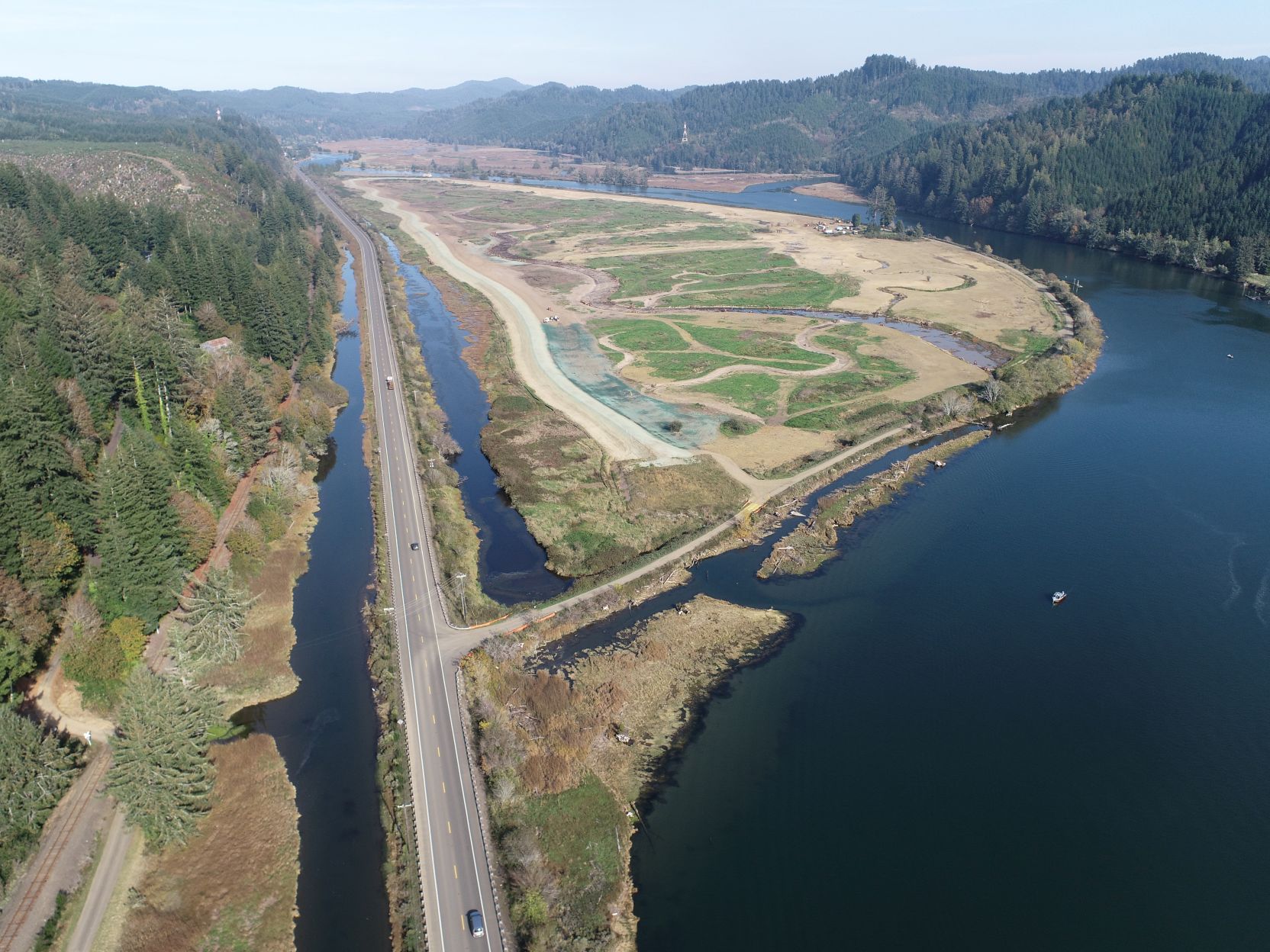
Photo Credit: $copyright
Funny thing about draining wetlands for livestock; over time, heavy hooves and tidal disconnect can actually compress the earth so much that water seeps back in regardless.
That’s what happened at one 217-acre property on Oregon’s lower Siuslaw River. Once, this site supported a viable dairy operation through a system of tide gates, levees, and drainage ditches. But by the 2010s, the pasture had sunk several feet into boggy mud, stressing cattle along with the ranch’s aging flood control infrastructure.
“It doesn’t make sense to farm here anymore,” says Eli Tome, the Director of Conservation at McKenzie River Trust, which now holds title to the land.
The lower Siuslaw watershed has supported rich agricultural uses over the past 150 years. It’s also a salmon stronghold: one of a select collection of wild river systems that sustain robust salmon runs—and could for generations, if critical habitat is restored and protected. Now, as sea level rise, climate change, and economic shifts alter the calculus for some coastal farmers and ranchers, groups like McKenzie River Trust and Wild Salmon Center are seeing more opportunities to restore tidal estuary and wetland habitat, particularly in Oregon.
As sea level rise and climate change alter the calculus for some coastal farmers and ranchers, we’re seeing more opportunities to restore tidal estuary and wetland habitat, particularly in Oregon.
In the early 2000s, McKenzie River Trust first approached the previous owners with a proposal to buy the land: an offer they eventually accepted. Then the trust, in partnership with the Confederated Tribes of the Coos, Lower Umpqua and Siuslaw Indians (CTCLUSI), Siuslaw Watershed Council, and others, launched the seeds of an ambitious plan to restore the property’s historic tidal character—while also maintaining flood security for residents and protecting Highway 126, a vital regional transportation corridor.
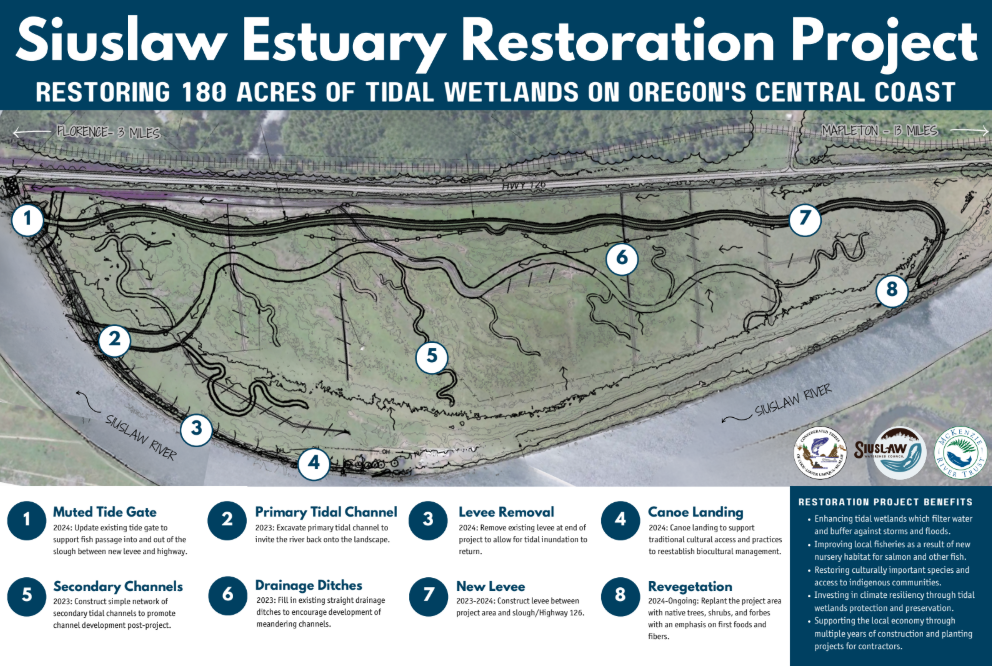
Photo Credit: McKenzie River Trust
For the Coos, Lower Umpqua and Siuslaw Indians, this project carved multiple pathways for cultural connection and revitalization. One example is through the formal renaming of the project site using traditional sha’yuushtl’a language. Where historical and traditional placenames exist throughout the Siuslaw River estuary, there was not one orally passed down or otherwise recorded for this piece of land.
In 2024, CTCLUSI officially re-named the property haich ikt’at’uu (“heart of the river”). CTCLUSI is the project lead for restoration implementation, weaving together multiple funding streams (including key funding from Wild Salmon Center) and Indigenous knowledge with western science. This summer, the years-long restoration project reached formal completion, following a dramatic levee breach in May and the flourishing of the site’s first revegetated plots, seeded with sedges, hairgrass, bulrushes, and other native marsh plants.
As of September 2026, haich ikt’at’uu looks nothing like the former dairy ranch. Roughly 180 acres are now riven with snakelike side channels that will feed tidal low marshes that will eventually extend to the property’s far northeastern corner. Where dry, compacted pasture once dominated, wetlands fill and drain twice daily with the tides. Over time, this natural process will deposit fresh sediment and create rich, diverse habitat. Eventually, cattails, crabapples, and giant Sitka spruce will fringe newly-established marshlands and swamps, and birds may once again flock to insect-rich mudflats at low tide.
Eventually, cattails, crabapples, and perhaps even giant Sitka spruce will fringe new marshlands and swamps, and birds may once again flock to mudflats at low tide.
As lush and tranquil as this landscape could soon look, it will still be hard at work, Tome says—maintaining balance between fish and wildlife habitat and buffering floodwaters from the adjacent highway and properties just beyond.
The new engineering is most obvious along the property’s western, downstream perimeter. Here, near a lowered stretch of the original levee, an old tide gate has been replaced with a modern muted tidal gate regulator system. (While traditional tide gates don’t allow for tidal water exchange or fish passage, the new system allows enough water to flow through to reach a desired elevation, as well as fish passage roughly 50 percent of the time, in response to the river’s ebb and flow.)
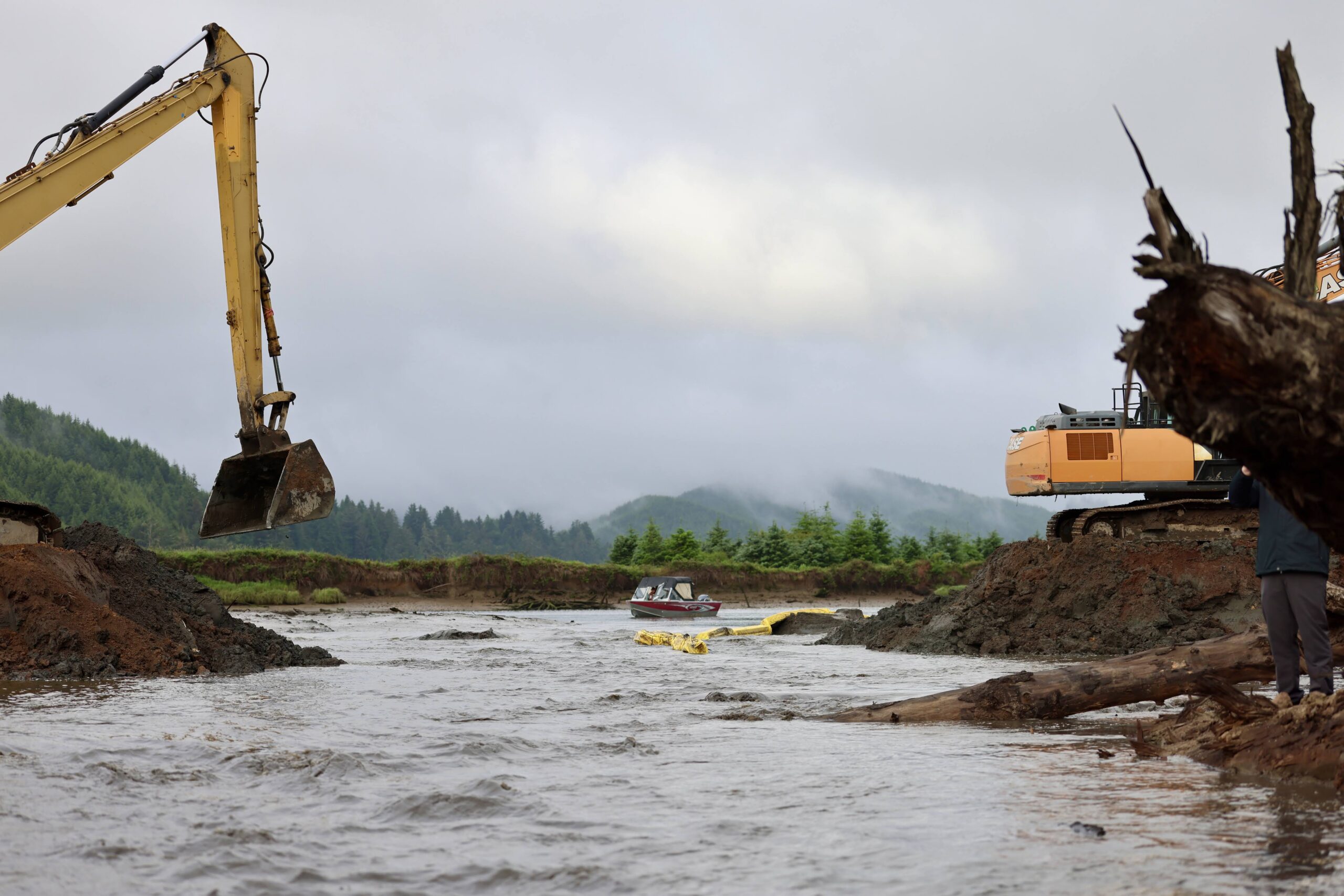
Photo Credit: Tim Moffett
Safeguarding coastal Highway 126 from the nascent wetlands, a robust new levee and access road now run the property’s length, curling around it like a protective arm. There is a canoe landing along the riverbank to support traditional cultural access and biocultural management. And where the old levee was fully breached this summer, a primary tidal channel now invites the river—and salmon—back into this part of its former floodplain.
“We need more of these projects, I believe, to bring back our salmon and our lamprey,” says Tribal Chief Doug Barrett. He remembers his grandfather describing fish runs so plentiful in the Siuslaw that one could cross the river walking on the backs of salmon. “Our little river was second only to the Columbia River,” Chief Barrett says. “That’s a lot of salmon that used to be there.”
“We need more of these projects to bring back our salmon and our lamprey.”
Tribal Chief Doug Barrett, Confederated Tribes of Coos, Lower Umpqua, and Siuslaw Indians
Today, Oregon Coast coho salmon remain listed as threatened under the Endangered Species Act. But according to Wild Salmon Center Oregon Coast Habitat Restoration Manager Cyndi Curtis, coho runs in the Siuslaw and some other Oregon rivers have been improving, likely due to favorable ocean conditions and intensive habitat restoration from the WSC-led Coast Coho Partnership and local partners like CTCLUSI, McKenzie River Trust, the Siuslaw Watershed Council, and the Siuslaw Coho Partnership. But according to Curtis, further efforts are needed to ensure that all Oregon Coast coho populations can recover—especially in times of poor ocean conditions, which are predicted in the coming years.
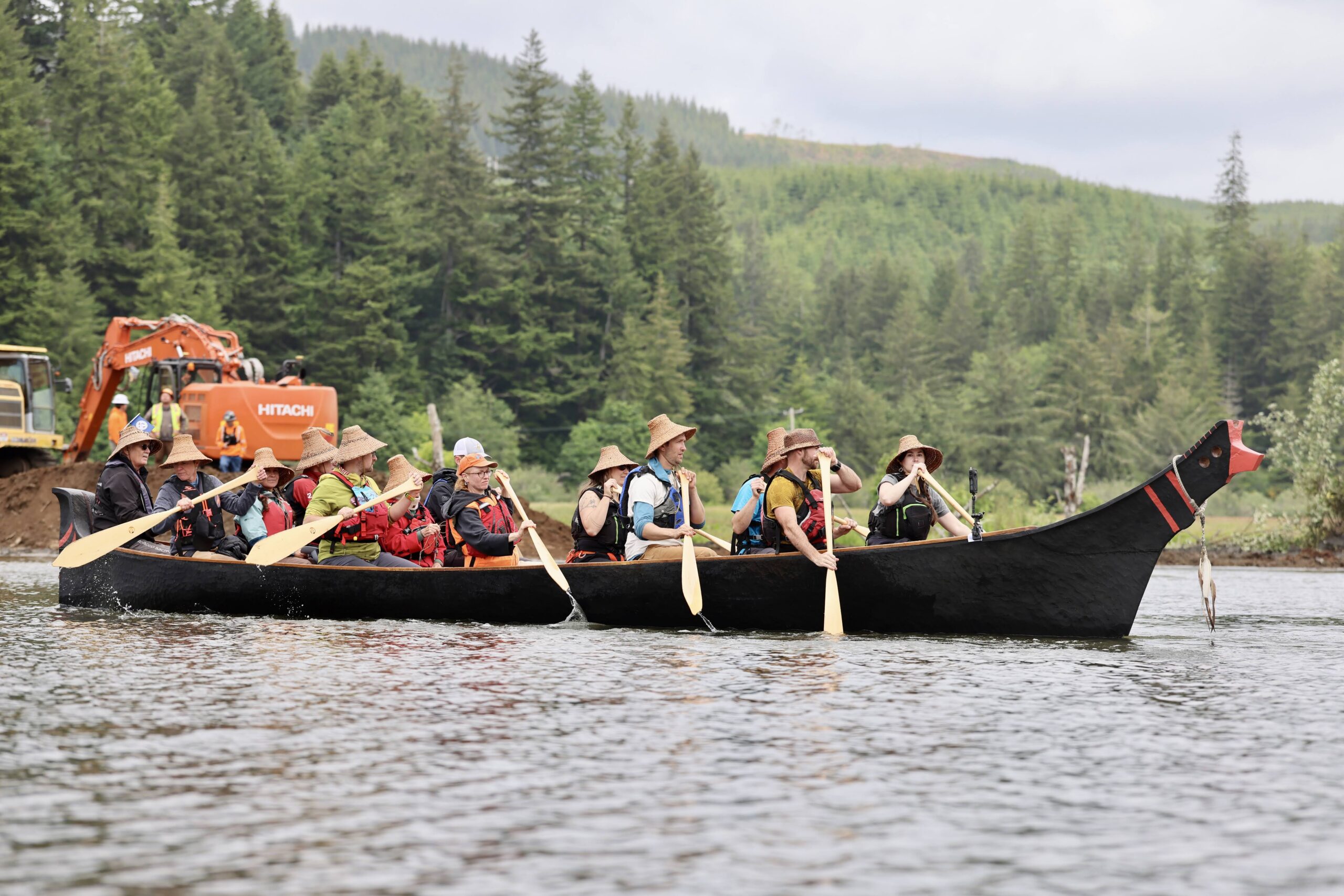
Photo Credit: Tim Moffett
Tidal wetland restoration projects like haich ikt’at’uu could play an outsize role in boosting salmon resilience, Curtis says. She hopes more landowners will hear the story of haich ikt’at’uu and consider wetland restoration.
“Tidal wetlands are where salmon have historically found the food and refuge they need to get big for the ocean stage of their lives,” Curtis says. “We’re beginning to fully understand how important these estuary habitats are for salmon, and coho in particular.”
“We’re beginning to fully understand how important these estuary habitats are for salmon, and coho in particular.”
Wild Salmon Center Oregon Coast Habitat Restoration Manager Cyndi Curtis
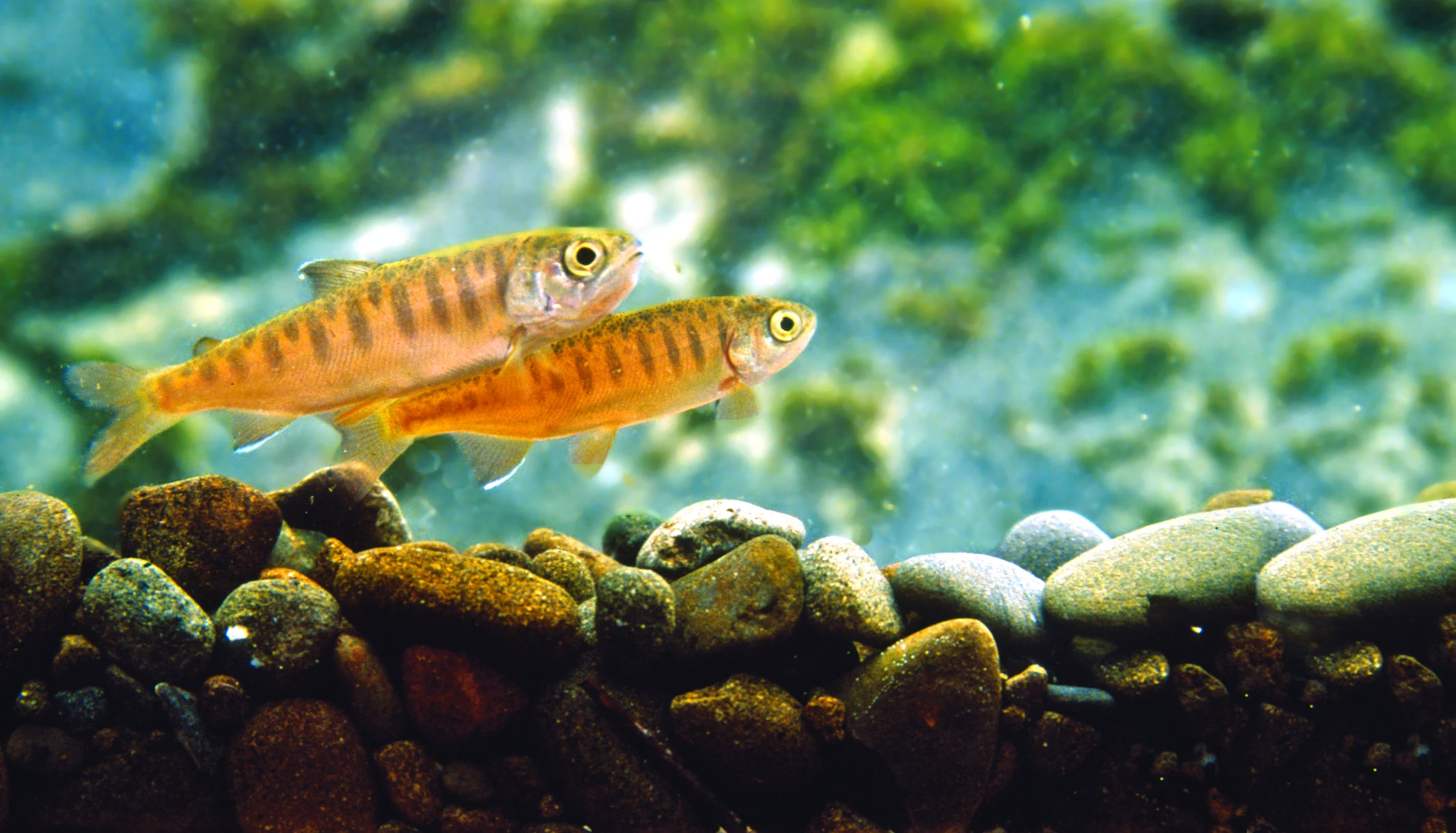
Studies have shown that juvenile salmon who spend time rearing in these tidally-influenced coastal habitats grow larger and healthier before their ocean adventures—with corresponding boosts in their overall fitness and survival later in life.
“Young salmon now have miles of additional channel they didn’t have before, right here near the estuary where they need it most,” Curtis says. “This is that rare story where everybody wins—from the landowners to the partners to the salmon and shorebirds. It’s a story we can and should bring to other salmon rivers.”
Photo Credit: Holden Films
Related News
At low tide, a high water mark for an Oregon restoration projectAugust 12, 2025 Bringing Back the Sitka Spruce SwampJuly 16, 2024 A New Path for Coho, Informed by the PastDecember 5, 2023Join the Movement
Stay up-to-date on what we’re doing for wild salmon and how you can help.
SUBSCRIBE